
A hardwood log can look promising from the outside and still present challenges once the saw opens it up. A crack running through the center, an old branch scar, hidden metal, or a change in grain direction can affect how much usable lumber comes from the tree. That is why custom sawmill work begins with understanding the log, not simply deciding how thick to cut the boards.
For property owners, woodworkers, and furniture makers in Pittsburgh, Pennsylvania, custom log milling offers a way to turn suitable timber into material for a specific project. A log might become a live edge dining table, a set of bookmatched slabs, hardwood shelving, or dimensional lumber for a furniture build. The best outcome depends on matching the cutting plan to the wood’s natural characteristics and the project’s actual requirements.
Donovan Woodworking & Sawmill offers several milling options, including live edge slab milling, dimensional lumber cutting, bookmatched slab production, custom cutting, hourly milling, and board-foot milling. Understanding how these services differ can help you decide what to do with your logs before valuable material is cut away.
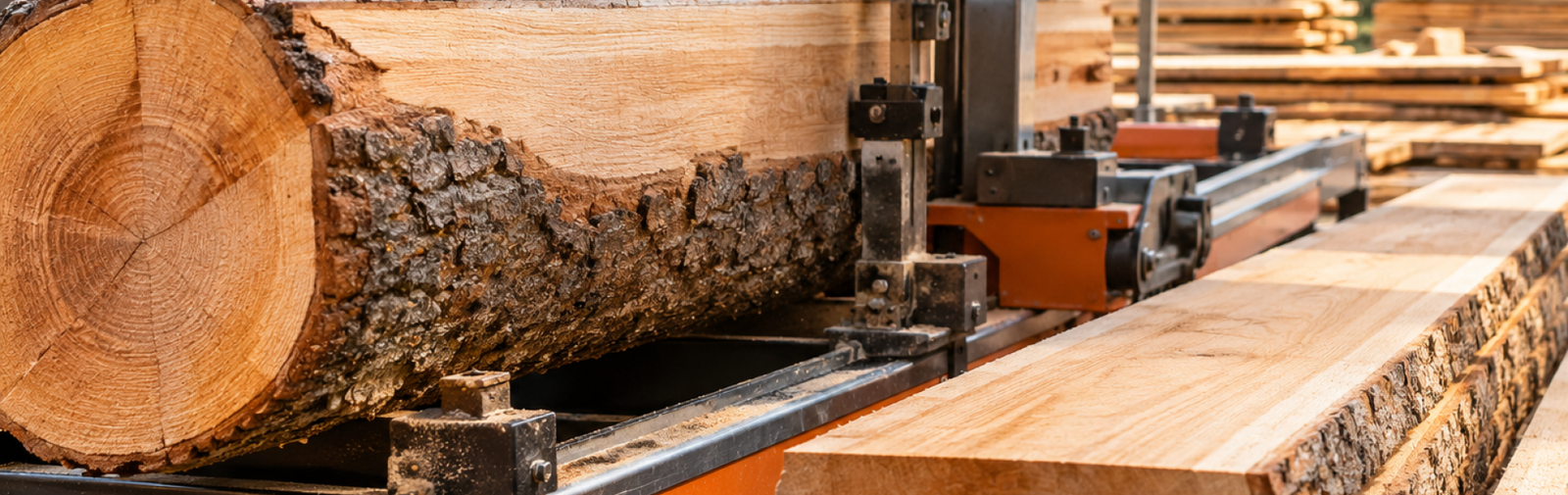
Why the Condition of a Log Matters More Than Its Appearance
A large, straight log does not automatically produce the best lumber. The tree’s species, growth pattern, internal condition, and previous exposure to weather all influence what can be recovered.
Hardwoods found across western Pennsylvania include oak, maple, cherry, and walnut. Each has its own grain characteristics and potential applications. However, even two logs from the same species can produce very different results.
For example, a walnut log with a relatively straight trunk may be a good candidate for wide furniture slabs. A log with a pronounced bend, substantial checking, or a large branch junction may require a different cutting strategy. The miller must consider where the defects are located and whether the desired boards can be cut around them.
The ends of a log often reveal useful clues. Radial cracks, known as end checks, may extend farther into the wood than they initially appear. A freshly cut end can also reveal color variation, growth rings, and some visible signs of decay. These observations help with planning, although they cannot reveal every internal defect.
The practical takeaway: Decide what you want the wood to become before choosing a cutting pattern. A log intended for a wide live edge table may need a very different approach from one intended to produce multiple smaller boards.
Live Edge Slab Milling for Custom Furniture
Live edge slab milling preserves some of the tree’s natural outer contour rather than trimming every board into a conventional rectangular shape. The resulting slabs are popular for dining tables, coffee tables, desks, benches, and statement furniture.
The width of the finished slab depends partly on the log’s diameter, but diameter alone does not determine the usable surface. Bark inclusions, splits, knots, decay, and the shape of the trunk can reduce the area available for a finished tabletop.
Consider someone planning a dining table from a locally sourced hardwood log. The initial log may appear wide enough, but the finished slab will need to account for trimming, defects, and the final edge profile. If the design requires two slabs joined together, both pieces also need to work visually and structurally.
It is worth discussing the finished dimensions before milling begins. If you need a particular tabletop length or width, communicate those requirements early so the cutting plan can be evaluated against the available wood.
Freshly milled slabs also need appropriate drying before they are used in most indoor furniture projects. Thick slabs can take considerable time to dry, and uneven moisture loss can contribute to checking, cupping, and twisting. The natural edge may need additional attention during drying because bark and sapwood can behave differently from the surrounding heartwood.
Dimensional Lumber Cutting for Practical Woodworking
Not every log needs to become a statement slab. Dimensional lumber is often the better choice when a project calls for repeatable board sizes, straight edges, or multiple pieces that need to fit together.
Custom-cut boards may be useful for shelving, furniture frames, cabinets, workbenches, and other woodworking applications. Milling from a selected log can also give a project a more consistent wood species and appearance than buying unrelated boards from different sources.
The important distinction is between the size of a freshly milled board and the size needed for the finished project. Lumber loses moisture as it dries, and that change can affect its width and thickness. Boards may also require flattening, jointing, planing, and trimming before they are ready for fine woodworking.
If a project calls for boards that finish at a specific thickness, the milling allowance needs to account for these later operations. Cutting a board to its exact final thickness while it is still wet may leave too little material for preparing flat, square surfaces after drying.
For furniture makers, planning the finished dimensions backward is often more useful than simply requesting boards of a particular rough-cut size.
Bookmatched Slabs and the Importance of Grain Selection
Bookmatched slabs are produced from consecutive cuts of a log that can be opened and positioned like the pages of a book. The resulting pieces may create a mirrored grain pattern, making them a popular choice for dining tables, conference tables, and custom river tables.
The effect depends on the natural structure of the wood. Grain direction, figure, knots, and color variation all influence how closely the two faces resemble one another. Bookmatching does not mean the pieces will be perfectly identical.
A log with interesting grain can produce a striking pair of slabs, but the cutting sequence matters. If a slab is cut too thin, damaged, or unsuitable for the intended design, the visual effect and usable dimensions may be affected.
Customers planning bookmatched furniture should consider more than the surface appearance. The finished pieces need suitable thickness, enough material for flattening, and appropriate drying before assembly. The table design should also account for natural movement as the wood responds to changes in indoor humidity.
For a project where grain symmetry is a major feature, discuss the desired appearance before milling rather than assuming every log can produce a matching pair.
Custom Cutting When Standard Lumber Sizes Are Not Enough
Some woodworking projects call for dimensions or grain features that are difficult to obtain from ordinary retail lumber. Custom cutting allows the milling plan to reflect the design rather than forcing the design to fit whatever boards are available.
A furniture maker might need several boards from the same log for a coordinated piece. Another customer may want thick stock for a heavy tabletop or wider material for a specific shelving layout.
The more clearly the intended use is defined, the easier it becomes to evaluate the available log. Useful information includes the required finished dimensions, the number of pieces, the preferred grain appearance, and whether the lumber will be used for structural or decorative purposes.
It is also important to remain flexible. A log’s internal defects may make the original dimensions impractical. In those cases, adjusting the design can preserve more usable material than insisting on a cut that the log cannot reasonably support.
Hourly Milling vs. Board-Foot Milling
The way a sawmill service is priced can influence how you plan your project. Hourly milling and board-foot milling measure different aspects of the work, so it is worth understanding the arrangement before the job begins.
How Hourly Milling Works
With hourly milling, the charge is based on the agreed hourly rate and the time counted under the service arrangement. The total may depend on the number of cuts, log dimensions, handling requirements, and the complexity of the job.
A project involving unusual slab dimensions or several different cutting requirements may need more time than a straightforward run of boards. Ask what the quoted hourly rate includes and whether setup, loading, or other handling tasks are billed separately.
How Board-Foot Milling Works
A board foot is a volume measurement commonly used for lumber. One board foot represents a piece of wood measuring 12 inches long, 12 inches wide, and 1 inch thick.
The formula is: Board feet = Thickness in inches × Width in inches × Length in feet ÷ 12
For example, a rough board measuring 2 inches thick, 12 inches wide, and 8 feet long contains 16 board feet.
The pricing method needs to be clarified because board-foot charges can be based on different agreed measurements. The volume of the original log, the volume of the sawn lumber, and the volume of finished boards are not necessarily the same.
Saw kerf removes material with every cut, and defects or irregular log shapes can further reduce the amount of usable lumber. Drying and surfacing can reduce the final dimensions as well.
Before comparing quotes, confirm whether the rate is based on input volume or output lumber, what measurement rules apply, and whether handling or additional services are included.
What Pittsburgh-Area Property Owners Should Consider Before Milling a Tree
The conditions under which a tree was removed can affect whether its wood is suitable for milling. Across the Pittsburgh region, trees may be removed because of storm damage, declining health, construction, or routine property maintenance. The reason for removal does not necessarily determine lumber quality, but it can provide useful context.
A tree that has been standing dead for a long time may contain decay or insect damage. A storm-damaged tree may have internal splitting that is not obvious from the outside. Logs left directly on damp ground can also deteriorate, particularly when the bark is damaged and moisture remains trapped against the wood.
Metal contamination deserves special attention. Nails, fencing, old hardware, and other embedded objects can damage sawmill blades and create safety concerns. If a tree grew near an old fence, building, or other metal structure, mention that history before the log is processed.
Storage conditions matter too. Keeping logs away from direct soil contact and minimizing unnecessary exposure to prolonged wet conditions can help preserve their potential. However, storing a log for too long does not improve its quality, and deterioration can continue while it waits to be milled.
Transportation and log handling should also be planned in advance. Large hardwood logs can be extremely heavy, and a log that is manageable in a wooded area may be difficult to load or move safely. Confirm access, handling arrangements, and any preparation requirements before scheduling the work.
Getting More Usable Lumber From Your Log
The goal of custom milling is not simply to produce as many boards as possible. It is to recover material that is useful for the intended project.
A cutting plan that prioritizes wide slabs may leave less flexibility for producing smaller boards. A plan focused on standard dimensions may sacrifice some of the natural edge or grain features that make a log distinctive. Neither approach is inherently better; the right choice depends on what the customer wants to build.
It helps to rank your priorities. Are you looking for one wide tabletop slab, a pair of bookmatched pieces, or the greatest practical amount of usable lumber? Are knots and color variations welcome, or do you need relatively clear boards? Would shorter pieces still be useful if a defect prevents a full-length cut?
These questions help guide the milling decision. They also make it easier to identify when a design adjustment could improve the final result.
It is equally important to distinguish between the amount of lumber produced and the amount suitable for the finished project. A log may yield several boards, but some could contain defects or require additional processing. Realistic expectations are more useful than relying on a fixed yield estimate before the log has been assessed.
Custom Sawmill Services in Pittsburgh, PA
Choosing a milling service begins with the wood you have and what you want to make from it. Live edge slabs can preserve the natural outline of a hardwood log, dimensional lumber can support practical woodworking needs, and bookmatched slabs can create distinctive grain patterns for custom furniture.
The log’s species, size, condition, and moisture content all influence the available options. A clear discussion of dimensions, grain preferences, handling, pricing, and drying requirements can help prevent avoidable problems later in the project.
Donovan Woodworking & Sawmill provides sawmill services for customers looking to turn suitable logs into useful lumber. Available services include live edge slab milling, dimensional lumber cutting, bookmatched slab production, custom cutting, hourly milling, and board-foot milling.
Frequently Asked Questions
Many hardwood logs can be milled, including oak, maple, cherry, and walnut, provided their condition and dimensions are suitable. The presence of decay, deep cracks, embedded metal, or extensive insect damage can limit the usable material. An assessment of the individual log is more reliable than judging it by species alone.
It can be worthwhile when the log contains suitable wood for a specific project, especially if you want a live edge slab, matching furniture boards, or lumber from a particular tree. The decision depends on handling and transportation costs, milling charges, the expected usable yield, and the time needed to dry the lumber.
The milling time depends on log size, the number and type of cuts, handling requirements, and the cutting plan. A simple set of boards may take less time than producing wide slabs or several custom dimensions. Milling time is also separate from the drying period, which can be considerably longer.
Logs do not generally need to be fully dried before sawing, and many are milled while green. However, the lumber usually needs to dry to an appropriate moisture content before it is used in indoor furniture or other moisture-sensitive applications. The suitable drying method and target depend on the wood and its intended use.