If you are planning a construction, remodeling, woodworking project in Pittsburgh, you may come across the term board-foot milling and wonder what it actually means.
A board foot is simply a standard way the lumber industry describes the amount of wood contained in a piece of lumber. Board-foot milling involves processing logs into lumber and using board feet to describe the quantity of material produced or sold.
For Pittsburgh property owners, understanding the concept can make it easier to communicate with a sawmill, compare custom milling services, evaluate a large tree that needs to be removed, and decide whether certain logs are worth saving for lumber.
This can be especially relevant with mature hardwood trees commonly found throughout Western Pennsylvania. Species such as oak, maple, walnut, cherry, and poplar may have potential value as lumber when a tree has to be removed because of storm damage, construction, disease, decline, or safety concerns.
What Is a Board Foot?
A board foot is a standard lumber measurement used to describe wood volume.
Rather than simply counting boards, lumber professionals use board feet to account for the thickness, width, and length of the material. This gives mills, suppliers, woodworkers, and contractors a consistent way to discuss how much lumber is involved in a project.
The important thing to understand is that board-foot measurement describes the amount of wood rather than automatically describing how much finished, usable material you will have after drying, trimming, surfacing, and other processing.
That distinction becomes particularly important when dealing with logs from residential or urban trees.
What Does Board-Foot Milling Mean?
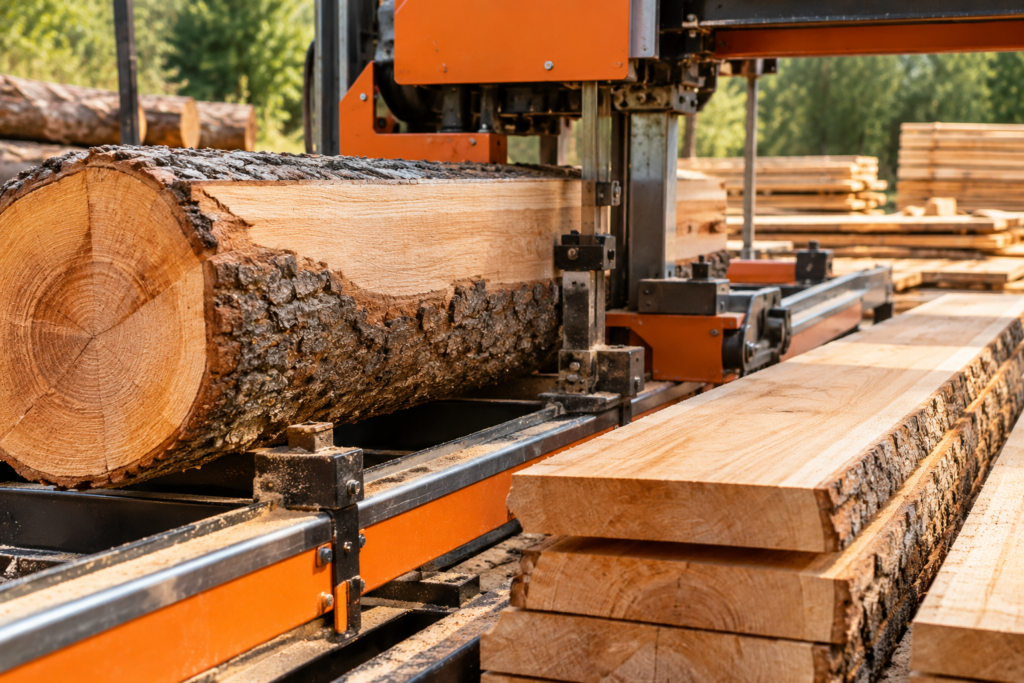
Board-foot milling generally refers to sawing logs into lumber while measuring the resulting material by board feet.
The process starts with evaluating the log. A sawyer looks at the species, diameter, length, straightness, taper, visible defects, and likely internal condition. These characteristics help determine how the log should be positioned and sawn.
The log is then processed into boards, slabs, beams, or other lumber products based on the intended application.
After milling, the lumber can be evaluated by board-foot volume. However, that measurement should not be confused with the amount of premium lumber that can eventually be used in a finished project.
A log may contain a large amount of wood but still produce less high-grade lumber than expected because of knots, cracks, decay, embedded metal, irregular grain, or other defects.
Why Board Feet Matter to Pittsburgh Property Owners
Board-foot measurement becomes particularly useful when a property owner has a large hardwood tree that needs to be removed.
Instead of automatically treating the entire trunk as waste or firewood, the owner may have the log evaluated for custom sawmilling.
A mature tree can sometimes produce boards suitable for furniture, shelving, countertops, mantels, flooring, decorative beams, or woodworking projects. The board-foot measurement provides a practical way for the mill and customer to discuss the amount of lumber being processed.
The value of a log, however, should never be judged by size alone.
A large trunk with internal decay may have less usable lumber than a smaller, healthy, straight-grained log. That is why an experienced evaluation is more useful than making assumptions from the tree’s appearance.
What Determines How Much Lumber a Log Can Produce?
Several factors influence the amount and quality of lumber recovered during milling.
Log Size and Shape
Large, straight logs generally provide more opportunities for producing useful boards. Taper, curves, sweep, and short sections can limit the types of lumber that can be produced.
Tree Species
Species influence appearance, durability, woodworking characteristics, drying behavior, and demand. Hardwood species commonly encountered in the Pittsburgh region can have very different milling characteristics and end uses.
Straightness and Grain
Straight trunks are generally easier to process efficiently. Unusual grain can sometimes create attractive boards, but heavily distorted growth can also make milling and drying more difficult.
Internal Defects
Rot, cavities, cracks, insect damage, included bark, old wounds, and other internal problems can reduce lumber recovery.
One particularly important concern with residential trees is embedded metal. Nails, screws, fencing, bolts, wire, signs, and other hardware can become trapped inside a trunk as the tree grows around it.
Metal can damage sawmill blades and create a serious safety concern, so the history and location of the tree should be considered before milling.
What Happens After Board-Foot Milling?
Freshly milled lumber is usually not ready to go directly into a finished woodworking project.
Newly sawn wood contains moisture that gradually leaves the lumber during drying. As that happens, boards can shrink, crack, cup, bow, twist, or change shape.
Proper lumber drying is therefore an important part of the process.
Depending on the species and intended use, lumber may be air dried, kiln dried, or handled through a combination of drying methods. Proper stacking and airflow are also important.
Pittsburgh’s changing seasons make moisture management worth paying attention to. Lumber exposed to outdoor humidity, rain, temperature changes, or poorly controlled storage conditions can behave differently from wood kept in a controlled environment.
For a property owner planning to use locally milled lumber indoors, asking about moisture content and drying requirements before milling can prevent problems later.
Can Residential Trees Be Milled Into Lumber?
Yes, but suitability varies from one tree to another.
Residential and urban trees often grow under conditions that can make them different from trees grown in managed forests. They may have experienced heavy pruning, construction activity, fencing, landscaping work, utility interference, or other environmental stresses.
A tree growing close to an old building or fence may also have hidden hardware inside the trunk.
Access is another important consideration.
Even when a tree produces a potentially valuable log, the mill must be able to handle and transport it safely. Narrow driveways, steep properties, retaining walls, overhead utilities, landscaping features, and nearby structures can complicate removal and log handling.
For this reason, it helps to consider tree removal and milling together rather than treating them as completely separate jobs.
What Should You Ask Before Hiring a Sawmill?
Before arranging custom sawmilling in Pittsburgh, ask how the company measures lumber, how its pricing works, what log sizes and species it accepts, and whether transportation is included.
It is also important to discuss the desired board thickness and intended use.
A property owner who wants lumber for a dining table may need a very different milling approach than someone looking for beams, siding, shelving, or general woodworking stock.
Ask whether the company handles logs from residential properties and whether it has procedures for detecting or managing embedded metal.
It is also useful to discuss what happens to slabs, offcuts, sawdust, and lower-grade material so there are no surprises once the milling begins.
Why the Intended Use Should Be Discussed Before Milling
One of the most overlooked parts of custom milling is deciding what you want the wood to become before the log is sawn.
If you want wide live-edge slabs, the log may be handled differently than if you need standard boards for cabinetry.
Similarly, lumber intended for furniture may be selected for appearance and grain, while lumber intended for other applications may place greater emphasis on consistency and dimensional stability.
Sharing the end goal with the sawyer allows the milling process to be planned around the characteristics of the log.
That can help preserve interesting grain, unusual figure, live edges, and longer usable sections that might otherwise be lost.
Board-Foot Milling After Storm Damage
Storm-damaged trees deserve special attention because property owners sometimes have to make quick decisions.
After a severe windstorm, heavy rain, or other weather event, a large hardwood may be damaged but still contain sections that can potentially be milled.
However, storm-damaged logs should not automatically be considered good lumber. Broken branches, twisting forces, cracks, uprooting, impact damage, and internal stress can affect the wood.
Safety should come first. A hazardous tree removal professional should determine how the tree can be safely taken down and handled. After removal, a sawmill can evaluate which sections may be appropriate for milling.
Keeping the tree removal and milling teams coordinated can reduce unnecessary cutting and help preserve better sections of the trunk.
Is Milling Better Than Turning a Tree Into Firewood?
There is no universal answer.
For certain hardwood logs, milling can preserve significantly more of the tree as usable material. A valuable trunk can potentially become lumber for furniture, shelving, flooring, architectural details, or future woodworking projects rather than being immediately burned.
At the same time, not every log is suitable for milling.
Wood that is badly decayed, severely damaged, too small, heavily curved, or contaminated with metal may be better suited to firewood, mulch, or another use.
The practical approach is to have the log evaluated rather than assuming that every large tree should be milled.
Common Board-Foot Milling Mistakes
One mistake is assuming that a large tree automatically means valuable lumber. The condition and characteristics of the log are often more important than overall tree size.
Another mistake is cutting a promising trunk into short sections before discussing the desired lumber with a sawyer. Cutting decisions made during tree removal can affect the options available at the sawmill.
Poor storage is another common problem. Freshly milled lumber should be stacked and supported appropriately so it can dry properly.
It is also a mistake to assume that board-foot volume represents the exact amount of finished lumber you will eventually use. Lumber may require trimming, drying, surfacing, grading, or other processing before it becomes suitable for a final project.
Choosing a Pittsburgh Milling Service
When looking for a Pittsburgh sawmill or custom milling provider, experience with hardwood logs is important, particularly when the wood comes from residential properties.
Look for a company that can explain how logs are evaluated, how lumber is measured, how drying is handled, and what factors influence yield.
A knowledgeable sawyer should also be comfortable discussing defects, log positioning, board dimensions, and the practical limitations of the material rather than simply promising a certain amount of finished lumber.
For property owners, clear communication before milling can prevent costly misunderstandings later.
Final Thoughts
Board-foot milling is a practical way to describe and process lumber from logs, especially when dealing with custom-sawn hardwood. For Pittsburgh property owners, the concept is useful when evaluating trees that need removal, comparing milling services, planning woodworking projects, and deciding whether a suitable log should be preserved as lumber.
The board-foot measurement itself is only one part of the picture. The species, condition, shape, grain, defects, drying requirements, accessibility, and intended use all influence the final result.
When a mature hardwood tree has to come down, it is worth asking whether the trunk has potential as custom-sawn lumber before it is hauled away. In the right circumstances, milling can give useful wood a second life and preserve material that might otherwise be discarded.
Frequently Asked Questions
Board-foot milling is the process of converting logs into lumber while using board feet as a standard way to describe the volume of the wood produced. It is commonly used when discussing rough-sawn and custom-milled lumber.
Yes. Suitable logs from residential properties can sometimes be converted into lumber. The tree species, trunk condition, size, shape, accessibility, and presence of hidden metal all need to be considered before milling.
Usually not. Freshly sawn lumber normally needs appropriate drying and storage before it is suitable for many interior woodworking applications. The required drying process depends on the wood species and intended use.
No. A tree’s size does not guarantee high-quality lumber. Internal decay, cracks, knots, irregular growth, embedded metal, storm damage, and other defects can significantly affect what can be recovered from the log.